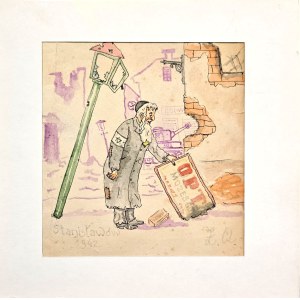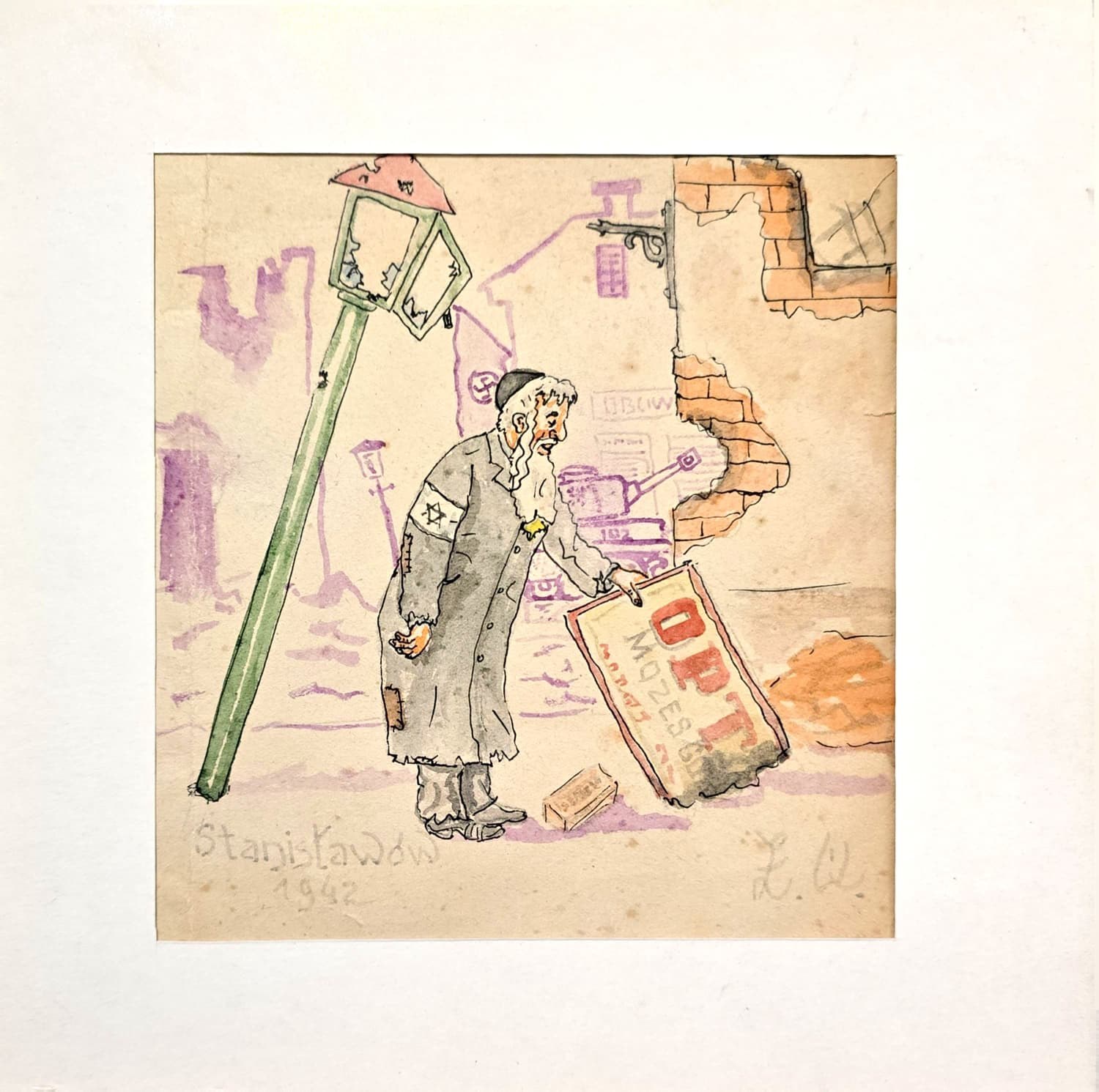
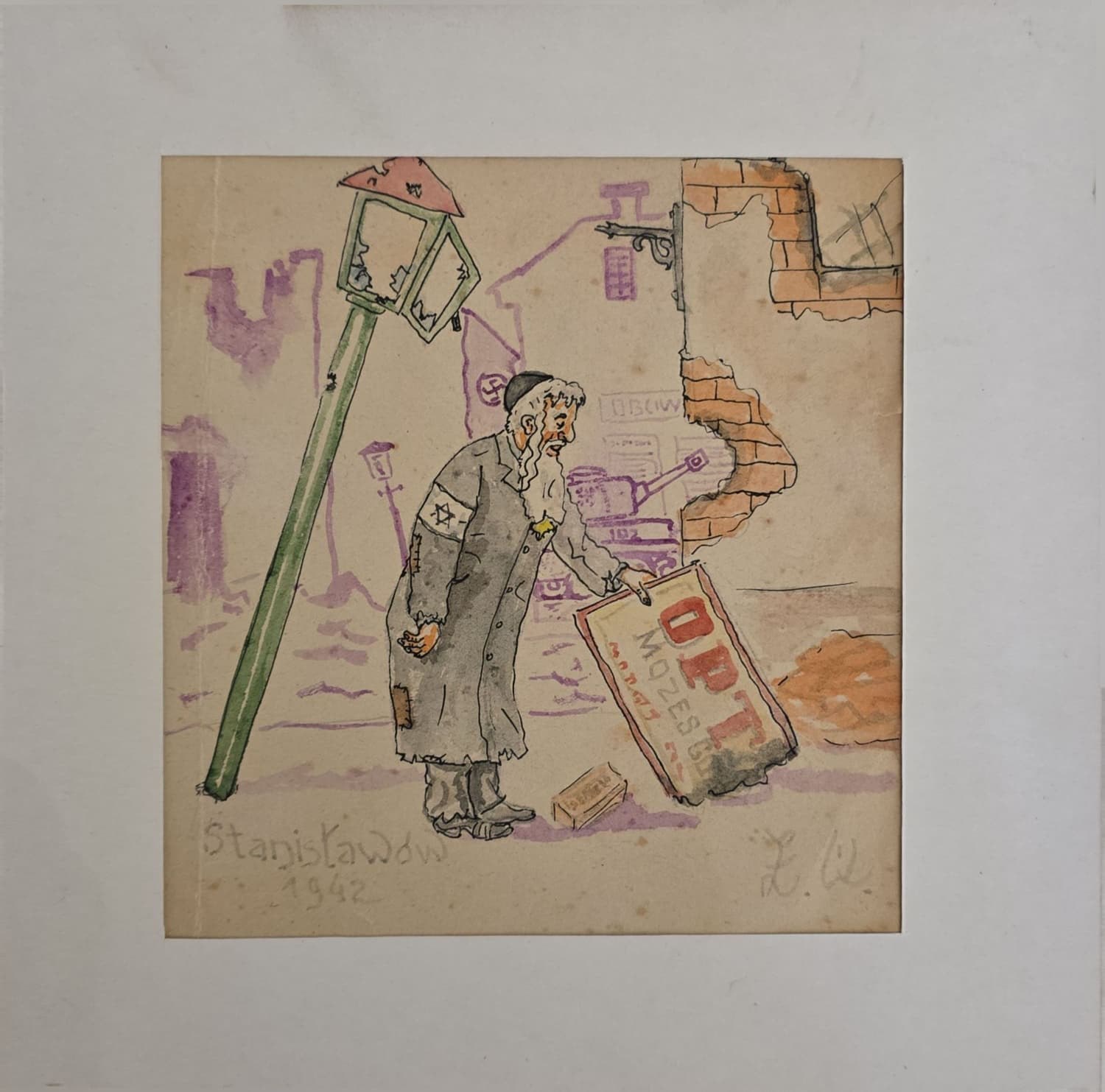
Lazar Weissmann / by Volodymyr Mychalczuk (?–2016), The Stanisławów Ghetto, 1942
Mixed media on paper, 20 x 19.5 cm / 14 x 13.5 cm
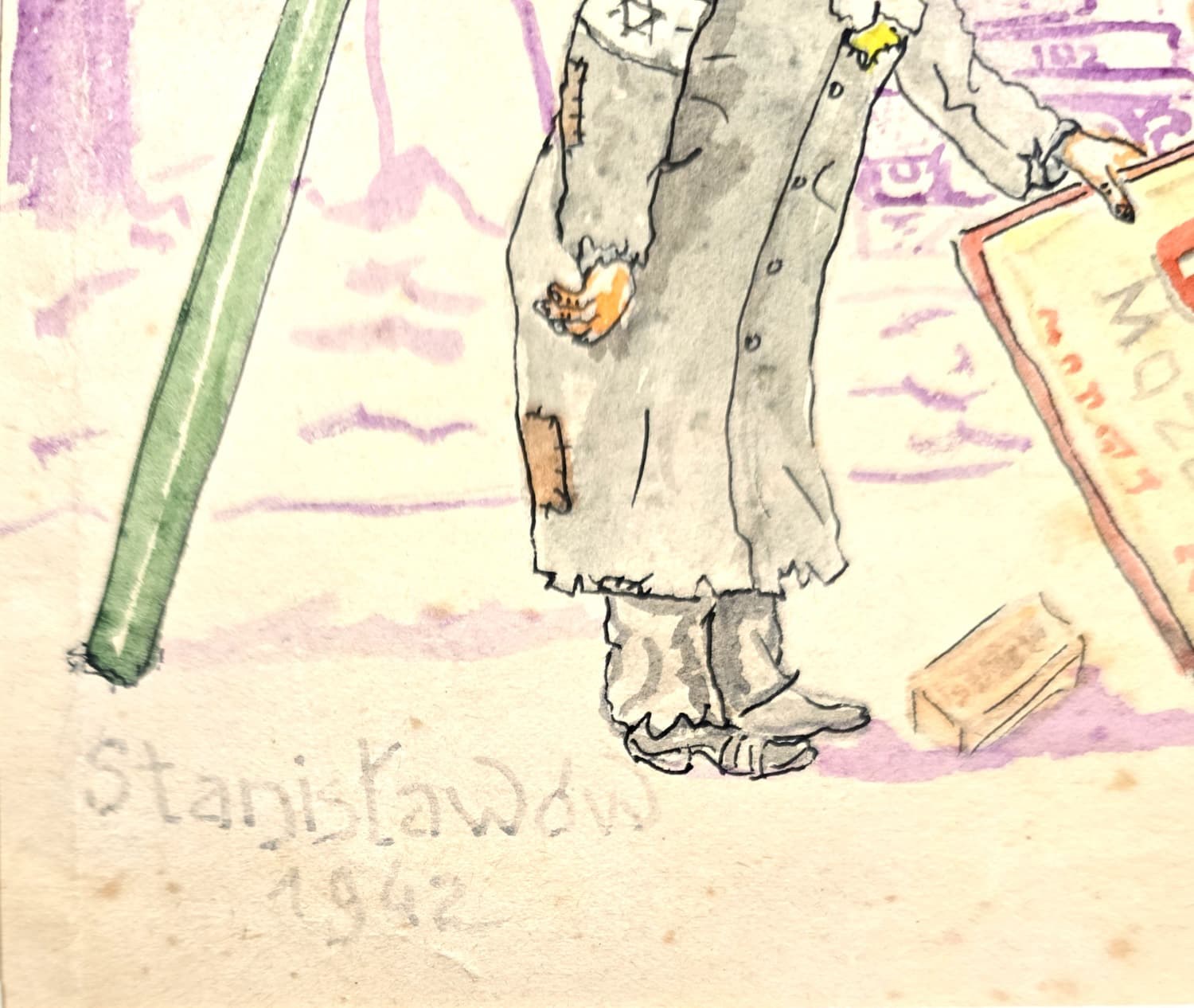
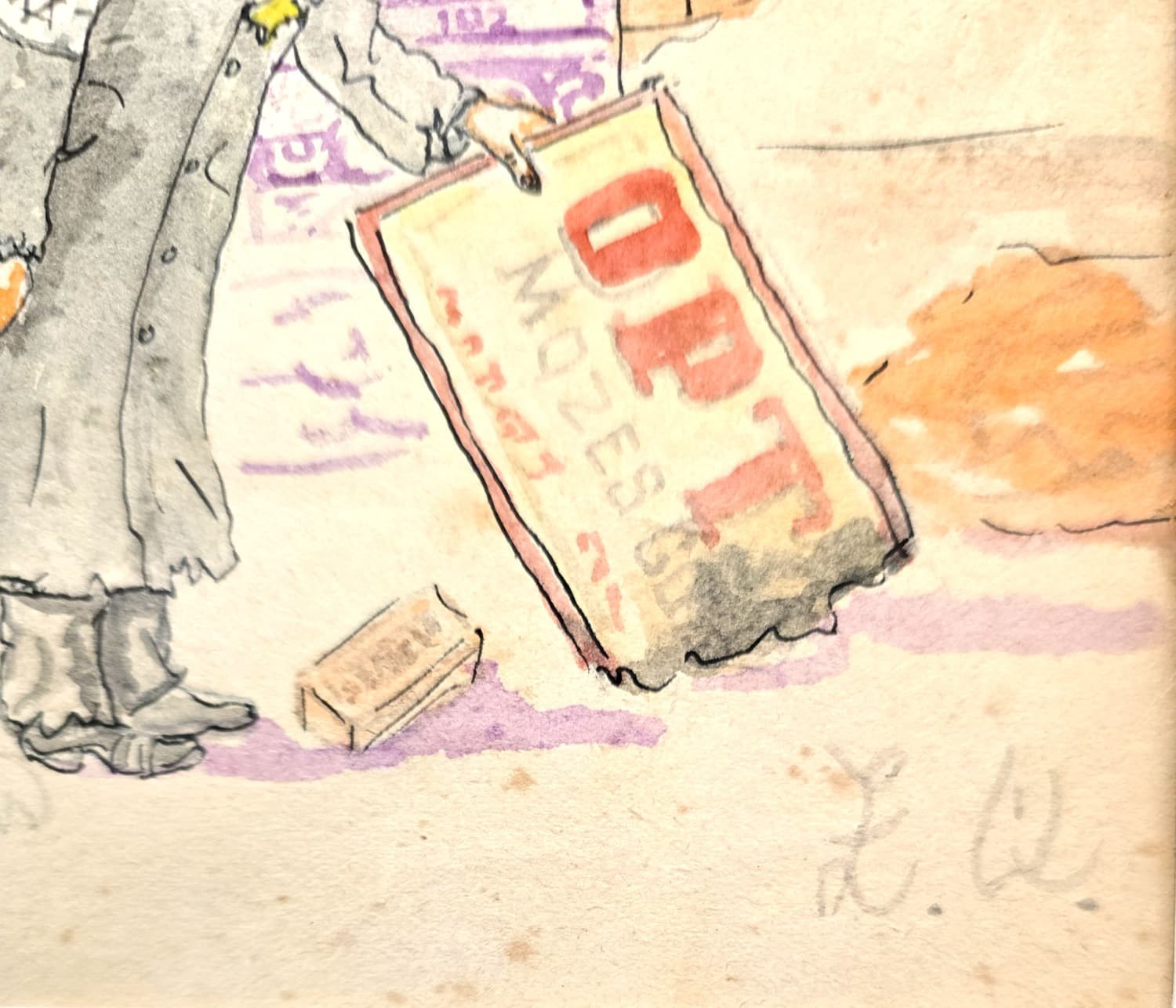
Signed “LW” in the lower right corner; date and place* “Stanisławów 1942” in the lower left corner.
Unframed.
*
The history of these small works attributed to the alleged Lazar Weissmann resembles an artistic detective story. For years, they appeared on the antiquarian market as works by a mysterious Jewish artist from Kolomyia, who was said to have created them in the 1920s and 1930s and then perished during World War II in 1942. Sometimes the Janów Camp in Lviv was cited as the place of his death, other times Auschwitz, but always in 1942—none of his known works were dated later than 1942.
The legend sounded convincing: the dates, the yellowed paper, the distinctive signatures, and the notes referring to various ghettos in what is now Ukraine (though always written in Polish). The works thus found their way to collectors in Ukraine, Poland, Western Europe, and even Canada, and were sometimes offered as authentic works from the interwar period.
In reality, the figure of “Lazar Weissmann” was actually the Ukrainian artist Volodymyr Mychalchuk (d. 2016), who was connected to Kolomyia: an illustrator, a man of the theater, a local history enthusiast, and a respected guide to Galicia. For a time, he also lived in Poland. In the early 21st century, he worked at a small optical shop in Łódź, where he came across pre-war magazines and depictions of Jewish life. It was these that inspired him to create his own imagined version of old Kolomyia.
After returning to Ukraine, Mychalczuk began producing entire series of such compositions. He styled them to resemble pre-war watercolors and drawings, also using old paper, sometimes actually dating from the 1930s. He depicted street scenes, shops, cafes, markets, schools, and the inhabitants of the former multicultural Galicia—Jews, Poles, and Ukrainians. He inscribed the works with old dates, the Polish names of the city—“Kołomyja” and “Stanisławów”—and the name of a fictional or at least elusive artist. According to people who knew Mychalczuk, he may have created over a thousand such “Weissmann” works.
The hoax proved exceptionally effective. For many years, collectors, antique dealers, and auction houses took an interest in the works, and the figure of Weissmann himself became shrouded in an increasingly romanticized biography. It was only through research conducted by the American scholar Ari Neumann, whose ancestors came from Kolomyia, that the true story of their creator was uncovered. Interestingly, to this day it has not been possible to determine with certainty whether a real Lazar Weissmann—whose works may have originally inspired Mychalczuk—ever existed at all.
In 2025, this extraordinary story was the subject of an exhibition at the Kolomyia City History Museum. There, Mychalczuk’s works were displayed no longer as “fake watercolors from the 1930s,” but as a distinct artistic phenomenon: a nostalgic, sometimes subversive vision of the world of prewar Galicia and a tangible trace of a myth that, for several decades, circulated in the art market almost as if it were true history.
[MK]